

Kung Fu (also referred to as Chinese martial arts) is a vast and diverse system encompassing a wide range of styles, techniques, and movements. Many of these movements and styles are designed to develop martial proficiency, but they also help enhance overall physical fitness, balance, agility, and coordination. Kung Fu’s movements are heavily rooted in principles of anatomical alignment, biomechanical efficiency, and functional application. Although interesting, don’t worry too much about what the movements are called, How they are pronounced and doing movements out of tradition or styles. Grasping the knowledge of how the movements originate or and are integrated could help but we should focus on the effectiveness and efficiency of the movement.
Core Key Movements in Kung Fu:
Below is a list of the essential and significant movements found in Kung Fu, categorized by the styles and explained in terms of their anatomical, biomechanical, and functional applications.
1. Stances (Postures)
Stances form the foundation of many Kung Fu techniques and are key for balance, structure, and power generation.
-
Common Stances:
-
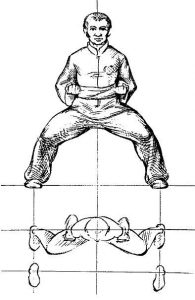
Horse Stance (Ma Bu): A wide stance where the feet are parallel and the body is lowered, commonly used for grounding and stability.
-
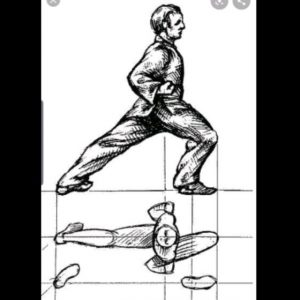
Bow Stance (Gong Bu): One foot forward in a step, the other back, with weight distributed between the legs, essential for strong and dynamic forward strikes.
-
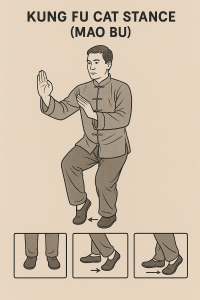
Cat Stance (Mao Bu): The majority of weight is on the back leg, with the front leg lightly touching the ground, often used for mobility and balance.
-
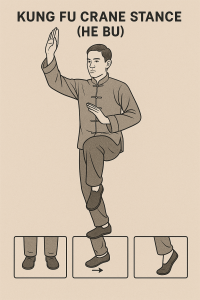
Crane Stance (He Bu): Standing on one leg, the other bent with the foot lifted, usually for quick transitions or strikes.
-
-
-
Anatomical and Biomechanical Applications:
-
Stances help align the body for optimal power generation, balancing the weight over the legs and improving the centre of gravity.
-
Proper use of muscle engagement in the legs and core promotes structural integrity.
-
Functional application: Stances allow for fast transitions between offense and defence, maximizing the ability to both block and strike from a grounded position.
-
2. Strikes (Fists, Palms, and Elbows)
These are the offensive techniques used in Kung Fu to create power and damage.
-
Common Strikes:
-
Straight Punch (Zhong Quan): A basic punch with a straight line of attack, often used to target the opponent’s midsection or face.
-
Back Fist (Hou Quan): A strike where the back of the fist is used for a quick and unexpected attack.
-
Palm Strike (Zhang Zhang): A strike using the open palm, ideal for targeting soft areas like the chin or solar plexus.
-
Elbow Strike (Zhou): A powerful close-range strike, ideal for inflicting damage in tight spaces.
-
-
Anatomical and Biomechanical Applications:
-
Strikes are delivered using the kinetic chain, where energy is transferred from the legs through the core and into the arms.
-
The alignment of the fist, wrist, and forearm is essential for minimizing injury and maximizing impact.
-
Functional application: Strikes are designed to disrupt the opponent’s structure, targeting vulnerable areas such as the head, ribs, and joints.
-
3. Kicks
Kicks in Kung Fu are used to target various levels of the body, including the head, torso, and legs.
-
Common Kicks:
-
Front Kick (Tiao): A kick that is directed straight out from the hip, usually aimed at the opponent’s midsection.
-
Roundhouse Kick (Hui): A kick that travels in a horizontal arc, aimed at the opponent’s head or midsection.
-
Side Kick (Cheng): A lateral kick performed with the side of the foot, often targeting the ribs or head.
-
Sweeping Kick (Di Quan): A low, sweeping motion to take an opponent’s legs out from under them.
-
-
Anatomical and Biomechanical Applications:
-
Kicks require precise control and activation of the hip flexors, quadriceps, hamstrings, and core muscles.
-
Proper biomechanics ensure that force is transferred efficiently from the supporting leg to the striking leg.
-
Functional application: Kicks provide versatile attacking options, from disrupting the opponent’s balance (sweeping) to delivering high-impact strikes to vulnerable areas.
-
4. Blocks and Parries
Defensive movements in Kung Fu are designed to redirect or absorb incoming strikes.
-
Common Blocks:
-
High Block (Shou Da): Used to defend against overhead strikes.
-
Low Block (Di Da): Used to block low attacks, especially kicks or sweeps.
-
Inside/Outside Block: Redirecting strikes that come toward the midline of the body.
-
-
Anatomical and Biomechanical Applications:
-
Blocks engage the arms and shoulders while maintaining strong alignment through the legs and core for stability.
-
Correct biomechanical positioning allows the practitioner to use the arms as levers, minimizing effort and maximizing efficiency.
-
Functional application: Blocks are not only defensive but can set up counterattacks, redirecting the opponent’s momentum and positioning for a follow-up strike.
-
5. Joint Locks and Grapples
These techniques are designed to control or subdue an opponent by manipulating their joints or body posture.
-
Common Techniques:
-
Wrist Lock (Shou Guan): A technique where the wrist is twisted to force an opponent to submit.
-
Arm Lock (Li An): A joint lock applied to the elbow, often used to disable the opponent or neutralize an attack.
-
Leg Sweep: A low technique that trips or disables an opponent by targeting their lower limbs.
-
-
Anatomical and Biomechanical Applications:
-
Joint locks require precise control over the opponent’s body, using leverage to create tension and force submission.
-
The biomechanics of leverage are crucial for generating maximum force with minimal energy expenditure.
-
Functional application: Locks control the opponent’s movement, disrupting their ability to attack or defend and setting up for follow-up techniques.
-
6. Forms (Tao Lu)
Forms are predefined sequences of movements that simulate combat scenarios. They are often used for practice to develop balance, precision, fluidity, and the integration of the aforementioned techniques.
-
Common Styles and Forms:
-
Shaolin Forms: Combines stances, strikes, kicks, and breathing techniques. Example: “Xiao Hong Quan” (Small Hong Fist).
-
Tai Chi Forms: Slow, deliberate movements to enhance balance, internal power, and relaxation. Example: The 24-step form.
-
Wing Chun Forms: Focuses on close combat with quick strikes and blocking. Example: “Siu Nim Tau.”
-
-
Anatomical and Biomechanical Applications:
-
Forms emphasize the fluid transition between movements, training the body to operate in a coordinated manner.
-
They enhance both aerobic and anaerobic conditioning by incorporating both quick movements and slow, controlled stances.
-
Functional application: Forms represent a complete martial scenario, integrating offense, defence, timing, and distance management in a fluid sequence.
-
7. Breathing Techniques
Breathing is critical to Kung Fu, not just for stamina, but for focusing internal energy (Qi) and enhancing power.
-
Common Breathing Techniques:
-
Abdominal Breathing: Breathing deeply into the abdomen to engage the diaphragm, enhancing endurance and focus.
-
Reverse Breathing: Inhaling during exertion and exhaling during relaxation to create internal pressure and focus energy.
-
-
Anatomical and Biomechanical Applications:
-
Deep breathing engages the diaphragm and core, allowing for better control over movements and enhanced stamina.
-
Proper breath control supports muscle oxygenation and helps in managing stress during intense physical activity.
-
Functional application: Breathing techniques help maintain focus, increase strength, and promote relaxation during combat.
-
Compound and Uniform Movements:
-
Compound Movements: In Kung Fu, compound movements involve multiple muscle groups working in unison, such as a punch combined with a stance change or a kick with a simultaneous block. These movements require the integration of strength, speed, and fluidity.
-
Biomechanics: Compound movements emphasize the integration of lower body power (from stances) with upper body movement (such as strikes). For instance, when executing a punch with a stance change, the hips and legs provide the driving force, while the upper body directs the strike.
-
Functional Application: Compound movements mimic real combat situations where a martial artist must perform multiple tasks simultaneously (e.g., blocking an attack while delivering a counter-strike).
-
-
Uniform Movements: These movements are performed as isolated actions, such as single punches, kicks, or blocks, with no additional actions integrated into the technique.
-
Biomechanics: Focus on efficient movement of a single body part (e.g., the arm for a punch), while the rest of the body remains still or in a neutral stance.
-
Functional Application: These movements emphasize precision, balance, and control, often used in forms or basic drills to develop fundamental martial skills.
-
In summary, Kung Fu movements are deeply integrated with the body’s biomechanics, anatomical alignment, and functional martial applications. By practicing the core movements, stances, strikes, and forms, a practitioner not only enhances their fighting ability but also their overall physical and mental well-being.
